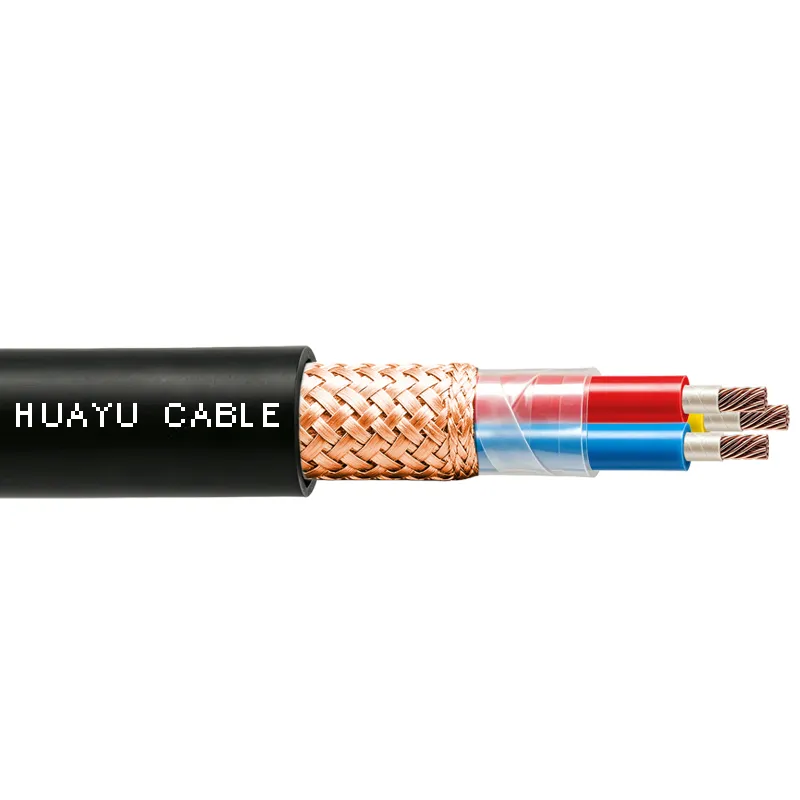
Fire-resistant cables refer to cables that can maintain safe operation for a certain period of time under flame combustion conditions. In common terminology for wires and cables, fire resistance is defined as the ability to maintain normal operation after being burned under specified test conditions for a certain period of time.
My country's standard "Test Method for Fire Resistance Characteristics of Wires and Cables" GB12666.6 specifies: Class A 950~1000℃, 90 minutes; Class B 750~800℃, 90 minutes. IEC 331-1970 standard specifies 750℃, 3 hours, equivalent to my country's Class B standard. The latest draft of IEC 60331, submitted for voting by the IEC, still specifies a fire temperature of 750℃~800℃, 3 hours. If this standard is adopted, my country will adopt it equivalently, and there will be no distinction between Class A and Class B fire-resistant cables.
Fire-resistant wires and cables can be further divided into flame-retardant fire-resistant wires and cables and non-flame-retardant fire-resistant wires and cables based on their non-metallic materials.
Mineral-insulated cables are entirely composed of inorganic materials magnesium oxide and copper, and their manufacturing process is complex. Mineral-insulated fire-resistant cables are non-combustible, smokeless, corrosion-resistant, non-toxic, and resistant to impact and spray, making their fire resistance the most outstanding among fire-resistant wire and cable varieties. Disadvantages of mineral-insulated cables include a more complex manufacturing process, higher price, limited manufacturing length, and a larger bending radius. Specific models include BTTZ (rigid) and BTTRZ/BBTRZ (flexible).
Fire-resistant cables rely on the fire-resistant and heat-resistant properties of mica materials in the fire-resistant layer to ensure normal operation during a fire. Halogen-containing cables rely on the flame-retardant effect of halogens, while halogen-free cables extinguish flames by releasing water to lower the temperature.