Fire resistance refers to the ability to maintain normal operation after being burned under specified test conditions for a certain period of time. According to the national standard GB12666.6, fire resistance ratings are divided into Class A (950–1000℃, 90 minutes) and Class B (750–800℃, 90 minutes). IEC 331-1970 standard specifies 750℃ for 3 hours, equivalent to my country's Class B standard. In the recently submitted draft of IEC 60331, the fire temperature remains 750℃–800℃ for 3 hours. If this standard is adopted, my country will adopt it, and there will be no distinction between Class A and Class B for fire-resistant cables.
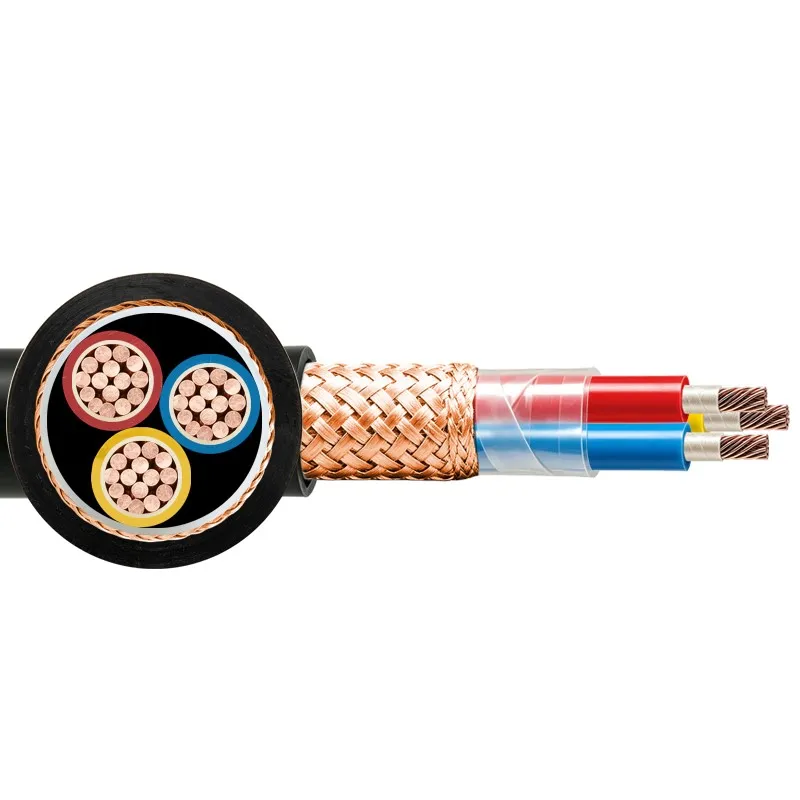
Mineral-insulated cables are non-combustible, smokeless, corrosion-resistant, non-toxic, and impact-resistant and spray-resistant, making their fire resistance the most outstanding among fire-resistant wire and cable varieties. Their fire resistance can reach over 950℃ for 180 minutes. Mineral-insulated cables are composed entirely of inorganic materials magnesium oxide and copper, offering advantages such as fire resistance, high temperature resistance, high mechanical strength, large current carrying capacity, explosion-proof properties, water resistance, corrosion resistance, long service life, and environmental friendliness.
Domestic mica-insulated fire-resistant cables primarily feature mica-coated conductors and extruded flame-retardant sheaths, with most being Class B products. In simulated fire tests, bare or exposed mica-insulated plastic fire-resistant cables maintain normal operation for approximately 27-30 minutes. Fire-resistant cables can maintain normal power supply for a period under fire conditions. However, mineral-insulated cables have a complex manufacturing process, higher price, limited manufacturing length, large bending radius, and are susceptible to moisture absorption. Large cross-section specifications are typically only available as single-core products, requiring permanent dedicated terminals and intermediate connectors, making installation more complex.
When selecting cables, in addition to fire resistance time, additional performance indicators such as smoke density, toxicity (e.g., halogen-free low-smoke), and operating temperature range should also be considered. Depending on the application, there are corresponding requirements for the flame retardant rating and environmental protection characteristics (halogen-free, low smoke, and low toxicity) of cables.